Key takeaways
- Physical SIM: insert card
- eSIM: download profile
- Network and plan decide speed
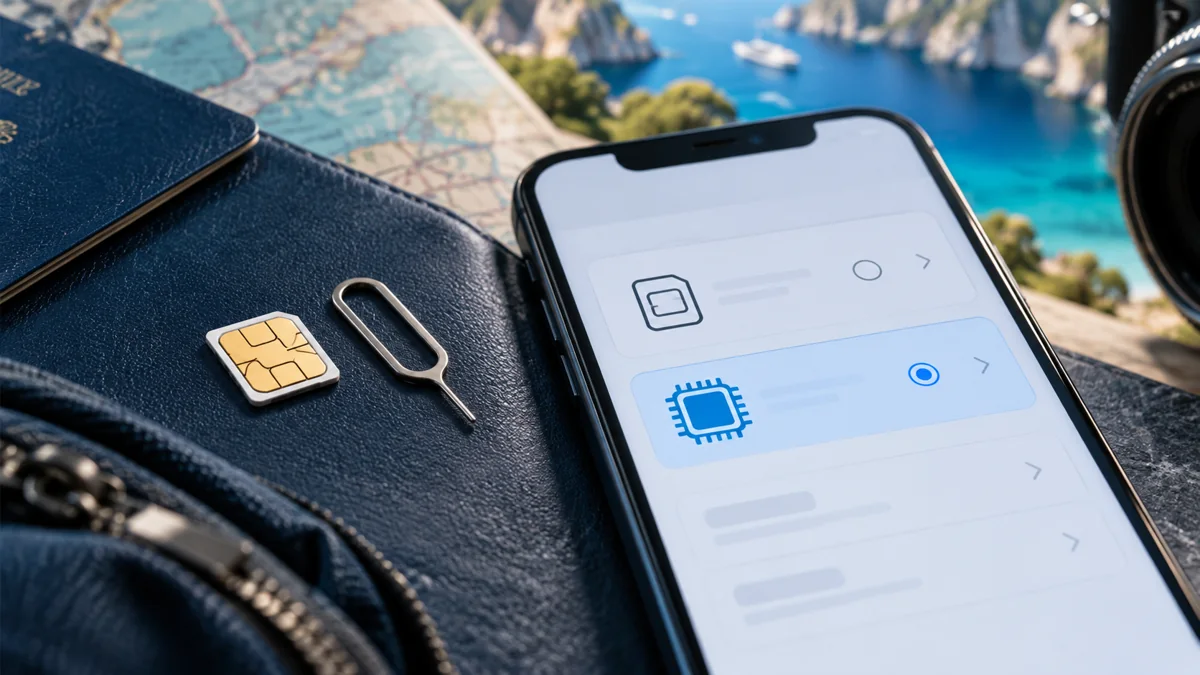
The eSIM vs physical SIM decision is mainly about digital installation versus a removable card; neither format is automatically faster, cheaper or more reliable. An eSIM and a physical SIM perform the same basic function: they identify a mobile subscription and allow a compatible device to access a cellular network. The difference is how the subscription is stored and activated. An eSIM is downloaded digitally to the device's embedded SIM hardware, while a physical SIM is inserted into the phone.
For international travelers, the best choice is determined by the plan and phone, not by an inherent speed advantage of one SIM format. An eSIM can be easier to install and manage before departure. A physical SIM may remain useful when the phone lacks eSIM support or when an appropriate local package is available only as a card.
eSIM vs Physical SIM: What Is the Difference?
The eSIM vs physical SIM distinction is digital provisioning versus a removable card, not an inherent difference in calling ability or network speed. The main difference is whether the mobile subscription is provisioned digitally or through a removable card. Both can support cellular data, phone calls and SMS when those services are included. Neither technology guarantees better network coverage.
| Feature | Travel eSIM | Physical SIM |
|---|---|---|
| Installation | Digital download or activation | Insert a compatible card |
| Purchase before departure | Often available online | Depends on retailer and delivery |
| Requires SIM tray | No | Yes |
| Local number | Depends on package | Depends on package |
| Data-only options | Common | Available |
| Keeping home SIM installed | Convenient on supported phones | May require dual physical slots |
| Transfer between phones | Provider/device-dependent | Often possible by moving the card |
| Network speed | Depends on plan and network | Depends on plan and network |
| Lost removable card | No physical card to lose | Card can be lost or damaged |
A digital profile is not equivalent to a new phone number. Likewise, a physical card is not automatically a complete voice-and-data subscription. The included services are defined by the carrier and tariff.
The meaningful distinction is between provisioning a subscription digitally and provisioning it through a removable chip. Both methods authenticate with a compatible mobile network and both can carry voice, SMS and data when the service includes those features. A local store might offer a physical visitor package with generous calling benefits, while an online international profile offers data-only connectivity for the same destination. Neither product tells you much about the other solely through the SIM format. Evaluate the operator, frequency support and tariff rules separately from the technology used to activate it.
eSIM vs physical SIM: practical trade-offs
eSIM advantages
- Download a supported profile without swapping a card
- Keep a compatible home SIM alongside travel data
- No loose card to carry or misplace
What to check
- Exact device support and carrier unlock
- Transfer and reinstallation rules
- Calls, SMS and hotspot in the selected plan
Is an eSIM Faster Than a Physical SIM?
For eSIM vs physical SIM, neither format is inherently faster: identical network access and plan conditions can yield similar performance. No inherent speed advantage comes from the SIM format itself. Mobile speed depends on the local network, device radio, available frequency bands, congestion and the subscription's speed policy. Two equivalent plans on the same network can have similar performance regardless of SIM format.
An eSIM sold through an international roaming provider may have different network access or routing from a local physical SIM. That can influence real-world performance, but it is a characteristic of the service rather than the SIM technology. Comparing local networks is more useful than assuming digital means faster.
Speed tests can also give misleading results if the products are not comparable. One plan might connect to a different network, be assigned different service priority or route traffic internationally. Congestion can change within the same hour. A fair technical comparison would require the same operator, place, device and broadly equivalent subscription conditions. Without those controls, claiming that embedded profiles always outperform removable cards is unsound. If coverage matters for a remote trip, examine the provider's network partnership and geographic map rather than the shape of the SIM.
Which Is More Convenient Before International Travel?
In an eSIM vs physical SIM comparison, digital purchase often wins on convenience before departure, while a domestic physical card can be useful where on-site activation is necessary. An eSIM is often more convenient when the device is compatible and the plan can be purchased online. Travelers can obtain a digital activation profile without visiting a store or handling a tiny card. Some services also allow the profile to be installed before departure.
Physical SIM cards may require collection at an airport, a mobile store or another retailer. In some destinations, locally issued cards require passport identification and in-person registration. However, a physical card can still be easy to use when the device supports it and the local operator provides straightforward activation.
Convenience depends on how the product is sold and activated, not merely whether it is digital.
Digital setup may save a visit to a mobile shop, but it depends on reliable internet during provisioning. A traveler can install an eligible profile using home Wi-Fi if the issuer's validity terms permit it. A removable card may be immediately usable once correctly inserted and activated, particularly where a store completes identity verification. Travelers with older devices also benefit from preserving a physical option. The right comparison includes the practical work required before, during and after the trip: delivery, registration, setup and troubleshooting.
Which Option Is Better for Keeping Your Home Number?
For eSIM vs physical SIM when keeping your home number, an eSIM often avoids removing the original card on a supported dual-SIM phone. An eSIM can be especially useful when the existing home number uses a physical SIM. On a compatible dual-SIM phone, the home card can remain installed while a travel eSIM handles mobile data. This reduces the need to remove and safeguard the original card.
Physical SIM travel can offer the same convenience on a phone with two physical SIM slots or an appropriate hybrid setup. However, a phone with one physical slot may require swapping cards.
Keeping the home line active does not guarantee free roaming. Voice calls, conventional SMS and certain automatic switching settings can still create charges. Check the home carrier's policies before departure.
For a working professional, keeping the original number can be essential because clients and banks already use it. A second digital profile may make this easier on a device with one physical tray, but a dual-physical-SIM phone can achieve a similar result. The important work happens inside the phone's settings: the preferred data line, voice line and any switching feature. Unexpected roaming costs can arise through the original subscription even when a prepaid data profile is active. Confirm billing conditions for messages and voicemail in advance.
Is an eSIM More Secure?
The eSIM vs physical SIM security trade-off favors a profile that cannot be physically removed, but both formats require secure accounts and device protection. An eSIM has an important physical security advantage: it cannot simply be removed from the phone like a conventional SIM card. Apple highlights this benefit when describing international travel with eSIM. However, digital provisioning introduces other security considerations.
Travelers should protect activation QR codes and carrier accounts because those credentials can authorize access to a mobile subscription. Device passcodes, account security and secure purchasing channels remain important. A physical SIM can also use SIM PIN protection, although that does not prevent the card itself from being removed.
Neither SIM format eliminates the risk of phishing, account takeover or unsafe public Wi-Fi. The more secure option is the one used with appropriate device and account protections.
The security comparison includes what happens if a phone is stolen. A removable card can be extracted and potentially used in another compatible device unless protected through appropriate account and SIM safeguards. An embedded profile cannot simply be pulled out, but a compromised device or carrier account creates other risks. Use a strong device passcode, account authentication and the manufacturer's lost-device tools. Protect activation codes and support credentials because they may be used in provisioning or account recovery.
What Happens When You Change or Lose Your Phone?
For eSIM vs physical SIM after losing a handset, removable cards can often move to a replacement phone, while eSIM reissue rules depend on the provider. A physical SIM can often be moved to another compatible unlocked phone. This makes it convenient when the original device fails during a trip. However, the card may be lost, damaged or unsupported by an eSIM-only replacement device.
An eSIM profile is not necessarily transferable by simply scanning the original QR code again. Transfer and reissue rules depend on the provider. Some mobile carriers support automated transfers, while certain travel eSIMs require customer support or a replacement profile.
This is particularly important for travelers carrying only one phone. Before buying, check whether the service supports reinstallation or transfer after device replacement. Do not delete an active eSIM without understanding the consequences.
A backup strategy should anticipate a damaged phone or an unexpected upgrade during a long trip. The easiest physical card transfer may be impossible when the replacement handset has no SIM tray. Conversely, a travel profile might not allow direct reinstallation on a replacement device even if that device supports digital SIMs. Store the purchase confirmation and the issuer's account recovery procedure securely. Before removing the old profile, verify whether the provider supports supported-device transfer, QR reissue or another authorized recovery method.

What About eSIM-Only Phones?
The eSIM vs physical SIM choice disappears on an eSIM-only model because there is no physical tray for a travel card. Some newer smartphones are sold without a physical SIM tray in specific markets. For example, certain U.S. iPhone models and U.S. Pixel 10-series models rely on eSIM. A physical travel SIM cannot be inserted into an eSIM-only device.
Device support also differs across regions. A smartphone model may be offered in versions with different SIM configurations or eSIM eligibility. Check the exact model number and country of purchase instead of assuming that every phone bearing the same brand name supports the same technology.
A device bought in one country may differ from the version sold in another, even when the product family name is identical. This is important for imported handsets, secondhand purchases and travelers using recent eSIM-only models. Verify the exact model identifier and original sales market against official support documents. An available settings menu is useful evidence but not a complete guarantee that any international plan will work. Cellular bands and carrier lock status still matter.
Better coverage. Smarter eSIM choices.
Compare travel eSIM plans by price, usable data, supported destinations and validity. Find the right balance for your journey.
eSIM vs Physical SIM for Long-Term Travel
For eSIM vs physical SIM on long stays, compare locally issued subscriptions and their voice, data and registration conditions rather than just the SIM format. A local physical SIM or locally issued eSIM can be worth comparing for extended stays. Domestic subscriptions may include a local telephone number, larger data allowances or conventional call packages. They can also require identity verification or a local address.
International travel eSIMs are often designed around shorter prepaid periods, but some support longer validity or top-ups. A traveler staying several months should compare total cost over the entire period rather than the initial package price.
The decision is not necessarily between digital and physical technology. The eSIM vs physical SIM decision often becomes secondary to domestic registration rules, required SMS and the quality of the local subscription. It is often between an international roaming service and a locally issued domestic subscription.
For stays measured in months, the most important decision may be obtaining a domestic service with a suitable number and local conditions. This might be sold digitally or as a card. Domestic products can have identification requirements, local-number benefits and different top-up arrangements from global visitor packages. Travelers should compare total long-term spending and service functions rather than treating digital versus physical as the main financial variable. Eligibility and accepted documentation can differ substantially across countries.
Which Type of SIM Should You Choose?
Choose eSIM vs physical SIM according to device compatibility, network access, required phone number, plan price and transfer flexibility. Choose a travel eSIM when the phone supports it, is unlocked and the package fits your itinerary. It is especially practical for keeping an existing line in place and preparing connectivity before arrival. A physical SIM can be the better option when the device lacks eSIM support or a local operator's physical package provides the required services at a better total cost.
Travelers should also consider the availability of a local number and SMS. A prepaid data-only eSIM may not replace a complete domestic SIM subscription. Compare the functions before making the decision.
What Is the Real Choice for a Family?
A family considering eSIM vs physical SIM should count compatible handsets and decide whether each person needs an independent connection. A shared phone hotspot may reduce purchases but makes everyone dependent on one battery, plan and network. Separate subscriptions improve independence, while a locally issued physical card remains an option for a family member with an older phone.
Frequently Asked Questions
These frequently asked questions resolve common eSIM vs physical SIM concerns about price, reception and using two lines at once.
Is eSIM cheaper than a physical SIM?
An eSIM vs physical SIM price comparison has no universal winner; tariffs and local distribution costs determine the result. Not inherently. Prices depend on the provider, included data, validity, network and purchase channel. Compare equivalent packages rather than the SIM technology alone.
Does eSIM have worse reception than a physical SIM?
In the eSIM vs physical SIM reception comparison, neither technology has an automatic signal advantage on equivalent supported networks. Not because it is an eSIM. Reception depends on the supported mobile network, phone and location. Different service agreements can produce different coverage.
Can I use an eSIM and physical SIM at the same time?
You can use both in an eSIM vs physical SIM dual-line setup when the phone supports a physical SIM plus an active eSIM. Many compatible dual-SIM smartphones support this configuration. The number of simultaneously active lines varies by device. Check the exact model and software.
Can I switch an eSIM to another phone?
For eSIM vs physical SIM transfers, a physical card can often be moved directly, while an eSIM may need a supported transfer or reissue. Sometimes, but the procedure depends on the provider and phone. Some services offer supported transfers, while others require a new profile. Do not assume an activation QR code can be reused.
Should I remove my regular SIM before traveling?
In an eSIM vs physical SIM setup, you need not remove the home card if your device supports a second digital line and you configure roaming carefully. Not necessarily. If the device supports dual SIM, you may keep the home SIM installed and select the travel eSIM for data. Review roaming and call settings to avoid unintended charges.
My quick checklist
Tick off the checks you have completed. Your choices stay in this browser.
0 of 3 checked
Official device support
Menu names and availability can vary by device, software and market. Consult current manufacturer instructions for your exact model.