Key takeaways
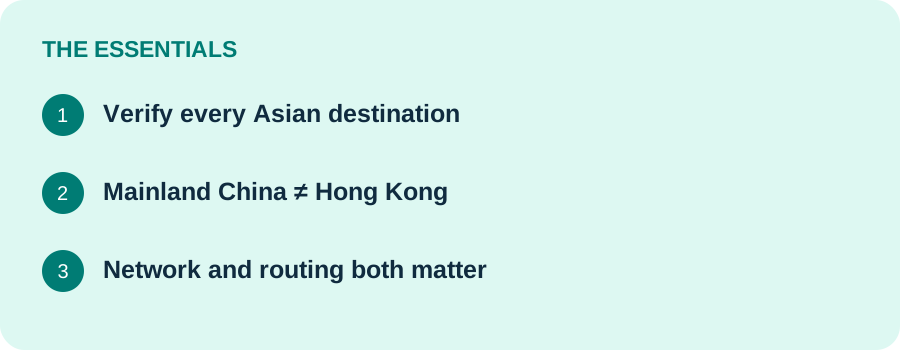
- Verify every Asian destination
- Mainland China ≠ Hong Kong
- Network and routing both matter
An eSIM Asia package can simplify journeys involving several Asian countries, but no universal destination list applies to all products. A regional profile might cover Japan, Thailand and Singapore while omitting other countries or separately listed territories. Choose it only after checking the complete route, local networks, data rules and validity.
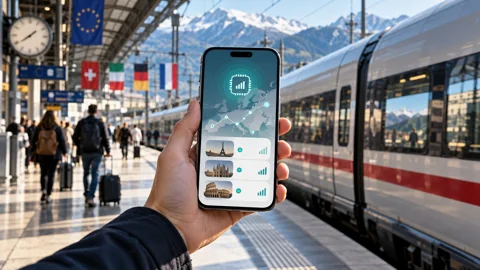
An eSIM Asia comparison should be especially precise around mainland China, Hong Kong and Macau, which may appear as separate coverage destinations. Southeast Asian island routes, mountain travel and multi-country border crossings also require realistic expectations for cellular reception.
Which Countries Are Included in an eSIM Asia Plan?
An eSIM Asia product includes only its published list of countries and territories. Some packages focus on East Asia, others on Southeast Asia, and some combine wider regions. The name Asia does not guarantee coverage in Nepal, Bhutan, Mongolia or any other specific market.
Before buying, write down every country you plan to visit. Compare that list with the package's actual eligibility information. Do not infer coverage from neighboring markets or a colorful regional map.
| Trip example | Destinations to check |
|---|---|
| Tokyo and Seoul | Japan, South Korea |
| Singapore and Bali | Singapore, Indonesia |
| Bangkok, Hanoi and Siem Reap | Thailand, Vietnam, Cambodia |
| Taipei and Hong Kong | Taiwan, Hong Kong |
| Hong Kong, Macau and Shenzhen | Hong Kong, Macau, mainland China |
| Delhi and Kathmandu | India, Nepal |
| Manila and Cebu | Philippines, including island coverage |
The table is an itinerary checklist, not a claim about any seller's inclusion list. Every commercial product must be evaluated separately.
A traveler should also check whether an eSIM Asia offer has a single shared allowance or applies country-specific data conditions. A product that looks regional at checkout may have different limitations in individual destinations. The eSIM Asia destination list should include named territories, not just flags grouped beneath one continental heading. If a visit includes an island or special administrative region, inspect that location directly. This avoids paying for a route that the product only partially supports.
When Is a Regional Package Less Expensive?
An eSIM Asia regional plan can be cheaper than buying many separate national packages when it includes every stop and a useful shared allowance. However, a trip dominated by one country may be less expensive with a national option plus a smaller second-country package.
Imagine six days in Japan and two in Korea. A large 30-day regional plan may be unnecessary if two short national packages are cheaper. Conversely, an 18-day trip crossing five countries might favor one regional purchase.
Compare the entire trip rather than an isolated cost per GB. Include validity, top-ups, activation rules and whether all countries share the same data balance.
To calculate a real trip cost, an eSIM Asia comparison should include all national packages that would otherwise be purchased. A cheap regional offer can win for a short multi-stop route but lose when the traveler spends almost the whole holiday in Japan. Compare an eSIM Asia option against the complete combination of national tariffs with matching validity and data. Do not rank products solely by how many countries they cover. Unused regional coverage is not an economic benefit by itself.
Regional convenience or local flexibility?
One regional plan
- Can reduce the need to switch profiles across included stops.
- Shares one allowance across the destinations listed in the product.
Separate country plans
- May fit different data needs at each stop.
- Require checking validity, installation and total combined cost.
How Does Southeast Asia Coverage Differ?
An eSIM Asia product is a broad marketing category, while a Southeast Asia plan usually targets a smaller selection of countries. Neither name guarantees identical membership across providers. A traveler combining Japan with Vietnam should verify that both are present.
East Asian destinations frequently include Japan, South Korea, Taiwan, Hong Kong and mainland China. Southeast Asia may include Singapore, Malaysia, Thailand, Vietnam, Indonesia, Cambodia, Laos and the Philippines. But these are geographic examples, not legally required plan contents.
Do not assume that a product covering Indonesia gives uniform reception on every island. Coverage within a listed country depends on the actual local network.
The eSIM Asia label is particularly easy to misread when a trip crosses East and Southeast Asian markets. Some travelers may assume that an eSIM Asia product includes India, Nepal and Bhutan because all are geographically Asian. Commercial destination lists are not required to match a school atlas. Write down every stop, including transit destinations where mobile data will be needed. Then use the verified provider country list to determine eligibility before comparing gigabytes.
Why Does Mainland China Need a Separate Check?
An eSIM Asia product that includes mainland China may still deliver an internet experience affected by routing and local controls. Cellular connectivity does not automatically mean unrestricted access to every website or messaging app. Some international roaming arrangements route traffic differently, but results vary and can change.
Hong Kong and Macau often have separate destination listings from mainland China. A plan including Hong Kong cannot automatically be used as proof of service in Shenzhen. All three must be explicitly included for a three-territory trip.
Avoid promising access to restricted services without verified product-specific evidence. Network availability and application accessibility are separate issues.
A mainland China stop requires two separate questions. Does the eSIM Asia product provide a supported Chinese mobile network, and what internet services will be accessible through its routing? The first is a coverage question; the second involves local internet controls and potentially different routing arrangements. An eSIM Asia listing for Hong Kong does not answer either question for Shenzhen. Refrain from promising access to particular apps unless the claim is currently verified for the chosen product and conditions.
Is Mobile Speed Consistent Across Asian Countries?
No. An eSIM Asia package may use different local networks in different countries and even different technical standards or frequency bands. Network quality depends on location, device and congestion. A 5G label is not a minimum guaranteed speed.
A package can work well in central Singapore but offer limited reception on remote Indonesian islands or mountainous roads in Laos. Check operator coverage for the actual destination. The roaming partner matters more than the size of the marketing coverage map.
For business use, verify available high-speed data, latency expectations and hotspot permissions. Some unlimited-style products slow down after specified thresholds.
A useful eSIM Asia comparison should give travelers a route selector rather than a single Asia checkbox. Include Hong Kong and Macau independently where products treat them separately, and allow multiple countries to be selected. An eSIM Asia package can then be ranked only if the route is fully covered. Show the supported local network and hotspot status when verified, along with estimated total cost. This helps readers choose between regional convenience and a more suitable combination of national products.
Find the right eSIM for your trip
Compare prices, coverage, data allowances and validity in one place. Choose a plan that fits your journey, not just the lowest advertised price.
What Are the Local Registration Differences?
An eSIM Asia travel profile obtained through international roaming can have a different enrollment process from a domestic SIM. Several Asian countries have identity registration rules for locally issued service, and some also impose device or IMEI requirements. The relevant rules depend on the service arrangement and jurisdiction.
A passport may be required for an airport-issued local subscription, while another international product may use online checkout. Neither eSIM technology nor a regional label overrides applicable national law. Verify current requirements before buying domestic service.
Travelers who need a local number or conventional SMS may find some domestic plans more suitable. Many international regional profiles are data-only.
How much data should you plan for?
A simple planning estimate, based on your own expected use.
How Much Shared Travel Data Should You Buy?
An eSIM Asia allowance should cover expected consumption across all travel days, including airport transfers and border changes. Estimate navigation, social media, video calls, streaming and hotspot use. Most travelers benefit from a buffer rather than buying the maximum available package.
At 0.8 GB daily for 14 days, expected consumption is 11.2 GB. Adding a 20% buffer gives 13.44 GB. This is a planning illustration, not a benchmark for every traveler.
Check whether the regional package shares data between countries or assigns separate allowances. Do not assume that one daily high-speed threshold works identically in every market.
Will the Connection Work Across Borders and Islands?
An eSIM Asia profile may re-register on a new supported network after a border crossing. Short service interruptions can occur, and a boat between islands may move outside terrestrial coverage. In-flight internet is a separate service.
A traveler visiting several Philippine islands should check the local partner's coverage rather than assuming that country inclusion guarantees every beach and ferry route. Similar issues apply to Indonesia and the Maldives.
Save tickets and accommodation details offline. A regional plan removes some purchasing steps but does not remove geographic network gaps.
How Should toptravel esim Compare Regional and National Plans?
The fairest eSIM Asia comparison begins with a multi-stop itinerary selector. Exclude packages missing any required destination, then check shared data, validity, local operators and hotspot rules. Finally compare total price with a combination of eligible national products.
A regional profile can be recommended when it is both complete and cost-effective. A country-specific option may win for longer stays with only occasional secondary destinations. Do not rank regional products higher simply because they cover more countries.
Convenience matters, but confirmed local network access and complete cost determine genuine value.
Frequently Asked Questions About Regional Asia Connectivity
An eSIM Asia FAQ should resolve common assumptions about regional coverage and cross-border data. These answers address the issues most likely to affect purchase decisions. Individual tariff terms take precedence over general geography.
Does One Asia Package Cover Every Country?
No. An eSIM Asia package covers only its published country and territory list. Check every destination, including smaller markets. Do not infer inclusion from a regional name.
Is Regional Service Cheaper Than National Plans?
Sometimes. An eSIM Asia product can reduce total spending on multi-stop journeys, but national packages may be cheaper for an itinerary concentrated in one country. Compare full-trip prices and allowances.
Are Hong Kong, Macau and Mainland China Included Together?
Only if all three are listed. An eSIM Asia product may treat them as separate destinations. Internet application access in mainland China also requires its own verification.
Can a Regional Package Be Shared With a Laptop?
Some products permit tethering, while others restrict it. An eSIM Asia plan must be checked for hotspot support and speed conditions. The phone also needs compatible hardware.
Will Your Phone Connect on Island Ferries?
Not continuously by default. An eSIM Asia profile uses supported terrestrial networks that may disappear offshore. Save important travel information before crossings.
My quick checklist
Tick off the checks you have completed. Your choices stay in this browser.
0 of 3 checked
Official device support
Menu names and availability can vary by device, software and market. Consult current manufacturer instructions for your exact model.