Key takeaways
- Check every destination
- Match days and data
- Read activation terms
An eSIM for international travel is a downloadable mobile subscription for supported destinations; the right one must cover your route, fit your phone and remain usable throughout the trip. Choosing an eSIM for international travel starts with three questions: where are you going, how much mobile data will you use and what services must work when you arrive? A suitable plan should cover every intended destination, remain valid for the complete trip and connect through an appropriate local mobile network. Price matters, but a cheap package that expires too early or does not cover your destination can become an expensive mistake.
An eSIM is a digital SIM profile that allows a compatible smartphone to connect to a mobile network without inserting a physical card. Many international packages are prepaid and focused on data, although some locally issued subscriptions include a telephone number and conventional calls. The best choice depends on the trip rather than the eSIM technology itself.
What is an eSIM?
An eSIM is a digital mobile subscription installed on a compatible device. The purchased plan still determines coverage, usable data, validity and included calls.
Compare SIM formats →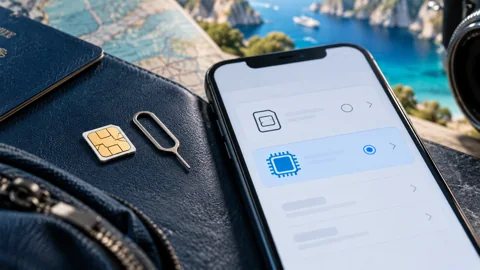
What Should You Check Before Buying an eSIM for International Travel?
To select an eSIM for international travel, verify the destination list, partner networks, device compatibility, validity, data allowance and calling features before comparing prices. Before buying, verify destination coverage, device compatibility, the data allowance, plan validity, network access and calling features. These six factors determine whether a package fits the trip. Comparing only the advertised price overlooks some of the most important limitations.
| Feature | Question to answer | Why it matters |
|---|---|---|
| Destination | Is every country or territory included? | Nearby countries may require separate coverage |
| Local network | Which networks can the eSIM use? | Reception varies by network and location |
| Data | How many gigabytes are usable? | An insufficient allowance may require a top-up |
| Validity | When does the clock start? | Installing early may shorten usable travel days |
| Phone compatibility | Is the device eSIM-capable and unlocked? | A locked or incompatible phone cannot use the plan |
| Calls and SMS | Is the product data-only? | Some services require a conventional number |
| Hotspot | Is tethering permitted? | Laptop users may need data sharing |
| Speed policy | Is high-speed data limited? | Unlimited marketing may include throttling |
Start with the destination list. A plan advertised for Europe may include most EU countries but omit Andorra, Monaco or certain Balkan destinations. Likewise, Hong Kong, Macau and mainland China can appear as separate coverage territories. A regional name is not a substitute for the complete country list.
Before payment, write down the exact travel route. For a flight into France followed by a train to Switzerland, it is not enough for a comparison card to say “Europe.” Switzerland needs to appear in the actual covered destinations or have confirmed supported network access. Apply the same logic to islands and overseas territories that are marketed differently from their neighboring countries. This five-minute check matters more than a prominent promotional headline. If your itinerary is still flexible, note likely side trips and compare whether a broader option remains cost-effective.
Better coverage. Smarter eSIM choices.
Compare travel eSIM plans by price, usable data, supported destinations and validity. Find the right balance for your journey.
Country, Regional or Global eSIM – Which Is Better?
For an eSIM for international travel, a national product usually makes sense for one country, while a regional or global product should earn its place by covering additional stops at an acceptable total cost. A country-specific eSIM is usually worth comparing first when the entire trip takes place in one destination. Regional plans become useful when crossing several borders, while global packages can make sense for frequent international travelers. None of these categories is automatically the cheapest or most reliable.
Country-Specific Plans
A country-specific eSIM for international travel is best when your entire trip takes place within a single listed country or territory. A national package is designed for one destination or a clearly defined territory. It may be suitable for a week in Japan, a holiday in Italy or a business trip to Canada. Check the local network and validity, because two packages for the same country can provide different conditions.
Regional Plans
A regional eSIM for international travel is useful when several countries on the itinerary are explicitly included under one validity period. A regional package can provide connectivity across multiple countries without changing profiles at every border. This is helpful for trips combining France, Switzerland and Italy or several Southeast Asian destinations. However, every country must be explicitly included, and performance can vary as the device moves between local networks.
Global Plans
A global eSIM for international travel is worth comparing when you cross several regions, but a global label never proves universal coverage. Global packages are intended for broader international coverage and can reduce the need to buy a new profile for every journey. They may be attractive to frequent business travelers or people visiting several regions. Their convenience should be compared with the amount of usable data and the cost of country-specific alternatives.
A multi-stop itinerary can make different coverage categories attractive on different days. Suppose you spend ten days in Japan and one afternoon in South Korea. A large Asia package is convenient, but separate national products could potentially cost less if the Korean data requirement is small. Reverse the scenario to five countries in ten days and a suitable regional package may become simpler. Compare the total checkout price, not merely the number of countries on the product page. A global label also does not remove a product's geographical exclusions.
Country-specific plans
For a trip focused on one named destination. Check validity and local networks.
Explore countries →
Regional plans
For several explicitly included countries. Check borders and special territories.
Check Europe coverage →
Global plans
For broader itineraries. A worldwide label still has a defined country list.
Understand global plans →Your plan in four checks
1Coverage
Check every destination against the actual coverage list.
2Duration
Confirm when validity starts and when it ends.
3Data
Estimate your whole trip, including hotspot use.
4Conditions
Read speed, activation and refund terms before checkout.
How Much Data Does an eSIM for International Travel Need?
Estimate data for an eSIM for international travel by listing your usual activities, multiplying their daily usage by travel days and allowing room for unexpected activity. The right allowance depends on daily usage rather than travel duration alone. A traveler using maps, messaging and occasional browsing needs much less data than someone uploading large videos or joining video meetings. Accommodation Wi-Fi can also reduce cellular consumption.
| Travel style | Illustrative daily mobile-data budget |
|---|---|
| Light: maps, texts, occasional browsing | 0.2–0.4 GB |
| Moderate: maps, social media, occasional uploads | 0.5–1 GB |
| Heavy: regular video, calls and hotspot | 1.5–3 GB or more |
These are planning examples, not measured averages or provider guarantees. Individual applications, video quality and background activity can change actual consumption substantially. A data calculator should allow travelers to enter the activities they expect to use.
For a seven-day trip with estimated usage of 0.7 GB per day, the initial requirement is 4.9 GB. Adding a 20% planning buffer brings the estimate to approximately 5.9 GB. In that example, a 6 GB or larger suitable package would be worth comparing.
Planning example: assume a week with four sightseeing days, two remote-work days and one long train journey. The sightseeing days might use maps, messages and photo uploads, while video meetings on workdays may consume far more. Instead of multiplying a heavy workday by all seven days, estimate the two usage patterns separately. Download offline maps for the train route while still on accommodation Wi-Fi. Then add a buffer for changing plans, lost connections or unexpected transfers. This produces a more credible allowance than selecting an arbitrary unlimited package.
Why Local Network Coverage Matters More Than 5G Advertising
Local network coverage determines whether an eSIM for international travel will connect at your destinations; an advertised 5G label alone does not establish signal or speed. A supported network determines where an eSIM can connect. The fastest advertised technology is not useful when coverage is missing at your hotel, on a rural highway or in a national park. A reliable LTE connection may be more useful than an advertised 5G connection that is unavailable on the actual route.
Check network information for the places where you plan to spend time. City coverage should not be used as proof of signal in mountains, remote islands or offshore areas. If connectivity is essential for work, verify coverage with the accommodation or local network information before buying.
5G access is never guaranteed solely by the eSIM label. The device, local network, subscription and location must all support the required technology.
Network selection can also affect a traveler who frequently crosses borders. Near a border, a phone may see towers belonging to more than one country. The service must be authorized to use whichever network it selects, and the plan's coverage list should be checked independently. On a long mountain hike, no SIM format can create coverage where the mobile operator has no tower within usable range. For safety-critical excursions, follow a guide's communication arrangements and carry downloaded route details. A speed label or a large allowance offers no substitute for actual signal.
When Should You Buy, Install and Activate Your eSIM?
Buy an eSIM for international travel after checking compatibility, and install it when the issuer's activation rules make early setup safe. Buying, installing and activating an eSIM are three different events. A package can often be purchased before departure, installed while connected to Wi-Fi and activated later when a supported network becomes available. However, some providers begin the validity period during installation or another specified event.
Read the activation policy before downloading the profile. If the plan starts immediately at installation, setting it up several days before departure could waste paid validity. If the provider permits early installation without starting the clock, preparing it at home can make arrival easier.
A practical sequence is to confirm compatibility, purchase the plan, review the validity rule and follow the provider's installation instructions. After landing, choose the travel line for cellular data and follow its roaming settings. Do not erase the profile merely because it does not connect while you are still outside its coverage area.
Create a small arrival checklist in the notes app: which line provides data, whether the travel line requires roaming, which network is supported, how to reach support and when the package expires. Keep this information available without internet access. If the activation instructions allow early installation, prepare the profile at home where Wi-Fi is stable. If installation immediately starts a short validity window, wait for the approved time. In both cases, keeping the issuing company's original instructions is more reliable than guessing at APN settings after landing.
How to Keep Your Home Phone Number While Using Travel Data
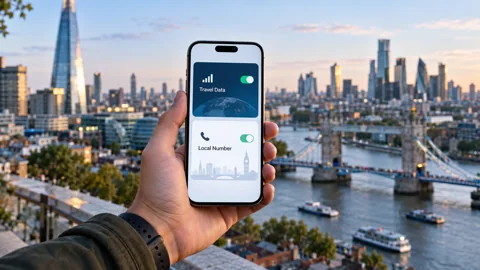
To retain your number while using an eSIM for international travel, keep a supported home line available for calls or SMS and deliberately assign mobile data to the travel line. Many modern smartphones allow a home line and travel eSIM to coexist. On a compatible iPhone, you can select the travel line for cellular data while keeping your home line available for ordinary communication. However, leaving your primary line active can still create voice, SMS or roaming charges depending on your carrier.
Choose the data line deliberately rather than relying on automatic switching. Review data-roaming settings for each line separately. If retaining the home number is essential for verification messages, check incoming SMS policies before departure.
Internet-based messaging applications can usually use the travel data connection while remaining associated with the original account. Conventional SMS and telephone calls operate differently and may require an active voice-capable line.
Retaining an existing number can be convenient, but it is not the same as keeping every home-carrier service free. Incoming calls, outgoing calls, voicemail and text messages may follow separate billing policies. Decide whether the home line should remain fully enabled, be used only for essential verification, or be temporarily disabled. Check how banking applications authenticate users before departure rather than while standing in an airport queue. An internet-based messenger can often continue through travel data, but ordinary SMS verification depends on a suitable cellular line.

How much data should you plan for?
A simple planning estimate, based on your own expected use.
The Seven Most Common Buying Mistakes
The most common mistakes when choosing an eSIM for international travel are skipping territorial exclusions, buying incompatible plans and confusing data-only service with ordinary phone calls. Travelers frequently make mistakes because eSIM packages look similar at first glance. Most can be avoided by checking the tariff details before payment. The biggest risks concern geographical coverage, compatibility and unexpected service limitations.
- Buying a Europe package without checking every destination.
- Purchasing before confirming that the phone is unlocked.
- Treating unlimited data as unlimited full-speed data.
- Assuming that a data-only package includes calls and SMS.
- Installing a plan before understanding when validity begins.
- Ignoring hotspot restrictions when planning laptop use.
- Assuming that a travel eSIM also includes cruise-ship internet.
The most expensive mistake is not always buying the highest-priced package. It is purchasing a plan that cannot provide the required service and then needing an additional connection.
A useful final review is to read each product's exclusions as carefully as its benefits. Look for phrases describing high-speed thresholds, prohibited tethering, single-use activation codes and refund restrictions after installation. These details can matter when a phone is lost, a trip is shortened or several devices need internet. Save confirmation of the purchased product, not only the marketing landing page. The final purchase should meet the route's requirements even if a cheaper-looking product is displayed above it.
How to Compare an eSIM for International Travel on toptravel esim
Use toptravel esim to compare an eSIM for international travel by required countries, usable data, validity and local network before looking at cost per GB. Begin by selecting your destination or all countries on your itinerary. Filter packages by validity and realistic data allowance, then review the supported networks, speed policy and hotspot conditions. Check the total price only after excluding options that do not fit your requirements.
A useful comparison should display data, duration and full cost together. It should also distinguish country, regional and global coverage. When several packages meet the requirements, calculate the effective cost per usable gigabyte and compare any significant restrictions.
The best eSIM for a trip is the least expensive suitable plan that provides the necessary connectivity – not automatically the cheapest advertised offer.
A Pre-Purchase Decision Worksheet
A traveler choosing an eSIM for international travel can run five yes-or-no checks before payment: every destination is included; the phone is unlocked; validity covers arrival through departure; usable data meets the planned budget; and the required calling or hotspot features are present. If any answer is no or unknown, eliminate the offer or obtain confirmation. This worksheet makes the final price comparison meaningful rather than letting a low advertised price override essential coverage.
For groups and families, determine whether everyone needs independent navigation. Sharing a phone hotspot can reduce the number of subscriptions, but the group must remain close to the host device and share its battery and allowance. Separate connections give family members more independence if they split up for attractions or transport. Travelers should also evaluate the ability to top up during a journey and whether customer support remains reachable when the purchased connection fails. These operational details are often more important than unused gigabytes.
Frequently Asked Questions
These answers address the questions travelers ask most often about an eSIM for international travel, from roaming bills to phone compatibility.
Is an eSIM better than international roaming?
An eSIM for international travel can cost less than a home carrier's daily roaming pass, but compare the total trip price and any required voice service. A travel eSIM can offer predictable prepaid data costs, while a home-carrier roaming package may be more convenient. The better option depends on your carrier's benefits, destinations and expected usage. Compare the full trip cost and included services.
Can I buy an eSIM before leaving the United States?
You can generally buy an eSIM for international travel before leaving the United States, provided your phone is compatible and you follow its activation policy. Yes, many international travel eSIMs can be purchased before departure. Check whether installation starts the validity period. Prepare the profile according to the provider's activation instructions.
Does an international eSIM work in every country?
No eSIM for international travel works in every country by default; check the product's explicit coverage list and local networks. No. Country, regional and global products have specific coverage lists. Even a global package may exclude certain destinations or territories.
Can I use my normal number with a travel eSIM?
An eSIM for international travel can often supply data while your normal number remains on an active home line, but home-carrier charges may still apply. Often, yes, on a phone supporting the required dual-SIM setup. The travel eSIM can provide data while your home line remains available. Your regular carrier may still charge for some voice, SMS or roaming activity.
How do I know whether my phone supports eSIM?
Your phone can use an eSIM for international travel only if the exact model supports eSIM, the device is unlocked for the service and the relevant networks are compatible. Check the exact manufacturer model, sales region and software settings. The phone must also be unlocked for use with another carrier where required. Confirm compatibility before purchasing.
My quick checklist
Tick off the checks you have completed. Your choices stay in this browser.
0 of 3 checked
Official device support
Menu names and availability can vary by device, software and market. Consult current manufacturer instructions for your exact model.