Key takeaways
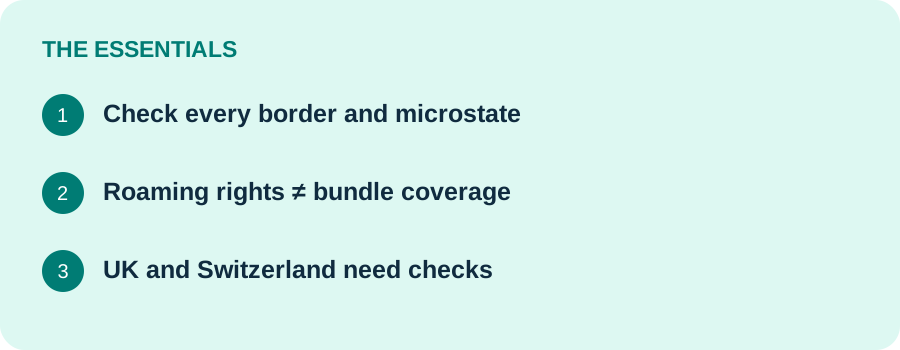
- Check every border and microstate
- Roaming rights ≠ bundle coverage
- UK and Switzerland need checks
One eSIM for Europe travel can cover a multi-country itinerary when every destination is explicitly included in the chosen product. It can simplify navigation and booking while traveling by rail or road. But Europe as a geographic idea, EU-regulated roaming and a commercial Europe eSIM are three different things.
Choosing an eSIM for Europe travel requires checking the UK, Switzerland, Western Balkans and microstates separately. There is also an important 2026 change: Ukraine and Moldova joined the EU's Roam Like at Home area on January 1, 2026. These regulatory benefits apply to eligible subscriptions; they do not automatically alter every commercial travel package's country list.
Does One eSIM for Europe Travel Cover Every European Country?
No. An eSIM for Europe travel covers the countries and territories listed in its tariff, not necessarily every place on the continent. A package labeled Europe may omit certain non-EU countries or small independent territories. Review the destination list before payment.
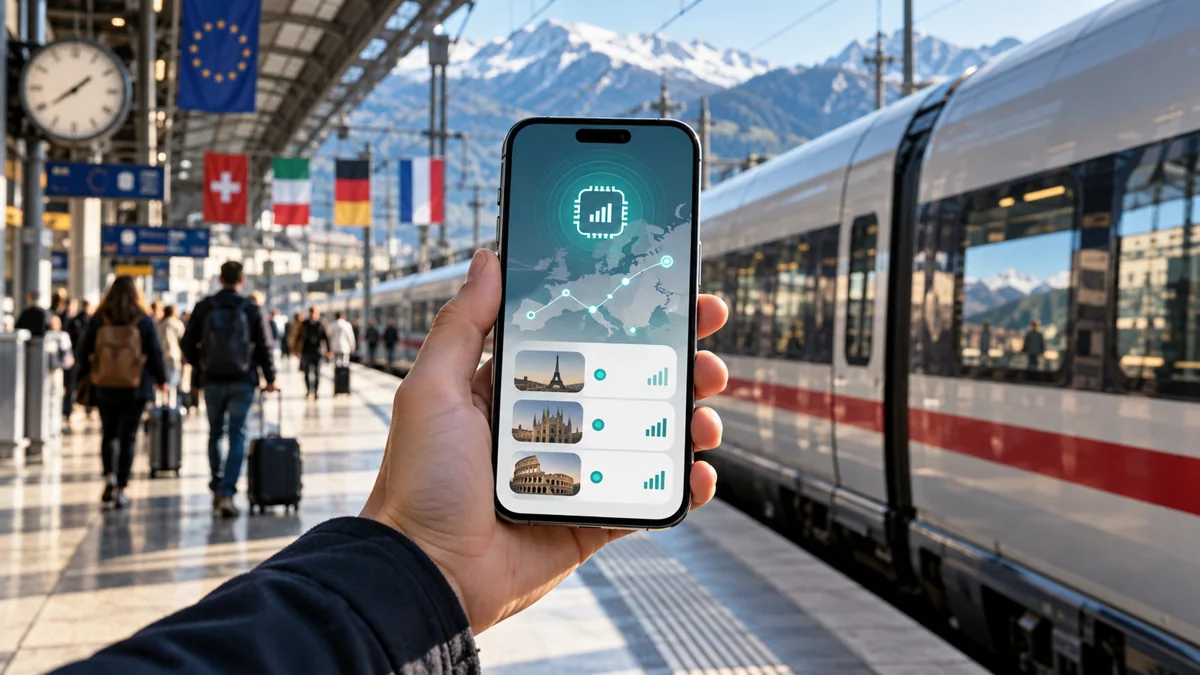
A rail trip from Paris to Geneva, Milan and Rome needs Switzerland as well as France and Italy. A London–Amsterdam–Berlin itinerary requires UK inclusion. A Balkan road trip may cross several countries with different roaming arrangements.
Check not only country names but also special territories and available local partners. A product that nominally includes a destination may still have weaker reception on rural routes.
A complete route list should include overnight connections, ferry arrivals and independent territories, not merely the countries where hotels are booked. For example, a train itinerary can pass through Switzerland even when the major planned stops are in France and Italy. The correct tariff may depend on whether you need internet during transit or only at each destination. A long tunnel can interrupt any terrestrial connection, so paid geographic coverage and uninterrupted service are two different promises. Regional coverage is valuable because it can reduce profile changes, but it does not remove the need to inspect the issuer's country list and local network partners. The practical test is whether your exact route has a supported connection when you need one, not how impressive a continental badge appears.
How Do EU Roam Like at Home Rules Apply?
An eSIM for Europe travel is a commercial prepaid product whose conditions are distinct from the EU's Roam Like at Home framework. Eligible home subscriptions can use the regulated roaming area under applicable domestic-rate and fair-use rules. That framework does not give a U.S. tourist automatic free roaming just for entering Europe.
The regulated area includes the 27 EU countries, the EEA states Iceland, Liechtenstein and Norway, and, from January 1, 2026, Ukraine and Moldova. The European Commission confirms that the UK is outside the automatic rules, although some carriers voluntarily retain benefits.
A travel eSIM may cover more or fewer destinations than the regulated area. Check the provider's own list even when traveling entirely within the EU.
The regulated roaming framework contains fair-use safeguards, especially for some unlimited or very low-cost domestic subscriptions. It is intended for eligible temporary roaming rather than permanent substitution of a home network. The data allowance available abroad can therefore differ from the domestic marketing headline while still complying with applicable rules. A U.S. visitor who purchases a separate international eSIM does not acquire these regulatory benefits simply by landing in Paris or Rome. That traveler is buying a new product whose contract defines the data, voice and territory. Keeping these arrangements separate is essential to avoid incorrect price promises. A country can be covered under the regulatory scheme for one subscriber and excluded from another traveler's commercial data plan at the same time.
An eSIM for Europe travel can look expensive beside an EU resident's existing roaming benefit, but these are different purchasing situations. For a visiting American, the relevant baseline is the US carrier's international tariff, not an EU domestic allowance. Compare the incremental bill you would incur if you kept your American line for data. Then compare a separate eSIM at the same countries, dates and required data amount. This prevents a misleading free-versus-paid comparison that ignores who is legally eligible for regulated roaming.
Check every border on your route
1Itinerary
List all countries and any island or territory stops.
2Package list
Check every stop against the selected product’s list.
3Home roaming
Review your carrier’s rules separately from travel-eSIM coverage.
4Transport
Treat ship and aircraft connections separately from land networks.
What Changed for Ukraine and Moldova in 2026?
Ukraine and Moldova entered the EU Roam Like at Home area on January 1, 2026, but an eSIM for Europe travel must still be checked for each destination. The regulatory change benefits eligible subscribers traveling within the applicable framework. It does not require every private international eSIM bundle to include both countries.
This matters for routes such as Romania–Moldova and Poland–Ukraine. A regional travel data product may list Moldova and Ukraine separately, and the available partner networks can differ. Check current entry and safety information independently of mobile coverage.
Regulated roaming rights belong to the eligible subscription and its rules. They should not be presented as a guarantee for a separate American prepaid travel product.
The January 2026 extension matters for cross-border commuters, visiting families and international visitors arranging regional travel. But it should not be interpreted as proof that all partner carriers provide equivalent speeds on every road or that a U.S. travel product has automatically updated its catalog. A person moving between Romania and Moldova must still check the account's eligibility and the actual destination network. For travel into Ukraine, the relevant safety and entry considerations require independent current guidance. Network inclusion cannot establish that a particular journey is advisable or possible. Editorial copy should state the effective date and distinguish a regulatory change from a commercial coverage claim, especially when readers compare plans issued outside the participating roaming system.
Are the United Kingdom and Switzerland Included?
An eSIM for Europe travel should explicitly list the United Kingdom and Switzerland if the itinerary includes them. The UK is outside EU Roam Like at Home following Brexit, although some carriers offer voluntary roaming benefits. Switzerland is in Europe and Schengen but outside the EU/EEA regulated roaming area.
A Europe package might cover both, one or neither. Do not infer eligibility from Schengen membership or the ability to cross a land border without routine checks. Those legal and geographic concepts are distinct from telecommunications agreements.
For trips to London and Paris or Zurich and Milan, compare the exact product's supported countries. A neighboring-country package is not automatically sufficient.
Switzerland demonstrates why travel geography is an unreliable proxy for roaming rights. A passenger can leave France on a train and arrive in Geneva without passing through a conventional airport immigration process, yet the cellular service may be billed under entirely different terms. The United Kingdom creates another common gap because some operators retain voluntary European benefits while others do not. A visitor traveling from London to Paris might find the same physical phone works in both countries while the underlying data billing changes. Compare the product's explicit destination list, not its logo or a generalized Europe promise. A short unsupported stop can be inconvenient during boarding, transit updates and navigation precisely when mobile data is needed most.
A traveler choosing an eSIM for Europe travel should mark the UK and Switzerland as explicit decision points. The two are popular destinations and frequent sources of incorrect assumptions. A package described as thirty European countries may still lack the very two countries you intend to visit. Enter the destinations before looking at a price and inspect coverage maps only as supporting evidence. A clear unsupported-country warning should appear alongside the comparison rather than requiring the reader to open several layers of terms.
What Is the Western Balkans Roaming Status?
An eSIM for Europe travel may include the Western Balkans as a commercial feature, but the EU's regulated roaming framework has not automatically covered all six partners as of October 2026. In June, the Council authorized negotiations with Albania, Bosnia and Herzegovina, Kosovo, Montenegro, North Macedonia and Serbia. Negotiating an extension is not the same as implementing it.
Check the tariff's country list for any Balkan itinerary. A Croatia–Montenegro–Albania road trip crosses mobile markets with different arrangements. A Serbia stop between EU countries should not be silently treated as domestic-rate roaming.
Some carriers have voluntary agreements that reduce roaming costs, but prices and eligibility remain carrier-specific. Do not replace a real tariff check with a general statement about the Balkans.
The six Western Balkan partners should not be merged into a single assumption about EU roaming. Albania, Bosnia and Herzegovina, Kosovo, Montenegro, North Macedonia and Serbia each need product-specific verification, even when a regional package claims Balkan coverage. Authorization of negotiations in June 2026 is a policy milestone, not an enforceable promise of domestic-rate service for every consumer. Individual carrier agreements can provide voluntary benefits independently of regulatory accession. This is why itinerary-based comparison beats a simple EU-versus-non-EU label. A traveler driving from Croatia through Bosnia and Herzegovina toward Montenegro could encounter multiple network changes over a short geographic distance. Review each country's inclusion and preserve maps offline for the border sections.
Find the right eSIM for your trip
Compare prices, coverage, data allowances and validity in one place. Choose a plan that fits your journey, not just the lowest advertised price.
Which European Microstates Can Create Coverage Gaps?
An eSIM for Europe travel may list Andorra, Monaco, San Marino, Vatican City and Liechtenstein differently. Liechtenstein participates in regulated roaming through the EEA, while Andorra and Monaco are not automatically included. Individual mobile networks and commercial tariffs determine other territorial arrangements.
Gibraltar, Jersey and Guernsey also deserve separate checks. A Spain or France eSIM should not automatically be assumed to work across nearby borders. The same applies to ferries using offshore maritime systems.
| Itinerary | Coverage checks |
|---|---|
| Paris–Brussels–Amsterdam | France, Belgium, Netherlands |
| London–Paris | UK and France |
| Geneva–Milan | Switzerland and Italy |
| Croatia–Montenegro–Albania | All three, including non-EU stops |
| Vienna–Bratislava–Budapest | Austria, Slovakia, Hungary |
| Romania–Moldova | Both destinations and current eligibility |
| Barcelona–Andorra | Spain and Andorra |
| French coast–Monaco | France and Monaco product terms |
Microstates can be especially confusing because visitors frequently treat them as day trips within a neighboring country. Andorra lies between France and Spain yet requires a separate coverage check. Monaco is adjacent to France but is not automatically covered by the same regulated roaming rules. Liechtenstein is an important counterexample because it participates via the EEA. The Vatican City and San Marino require product-specific network confirmation rather than assumptions based solely on Italy. Small islands and Crown Dependencies add another layer: Jersey is not simply an extension of a British national tariff, and ferry connectivity may introduce maritime service. A reader should be able to enter every stop in a destination selector, including territories too small to appear prominently on a map.
Microstate coverage is also an opportunity for useful internal navigation. An eSIM for Europe travel article can link to specific destination pages for Andorra, Monaco, Liechtenstein, San Marino and the Vatican where these pages exist. Each should clarify the local coverage rules instead of duplicating a generic Europe paragraph. A traveler going to Monaco for half a day might prefer a different solution from someone staying for a week. The comparison needs that context and must not assume that short distance equals included roaming.
How much data should you plan for?
A simple planning estimate, based on your own expected use.
How Much Mobile Data Is Enough for a European Trip?
An eSIM for Europe travel should provide enough data for navigation, tickets, accommodation and communication across the entire trip. Crossing borders does not inherently consume extra data, but rail searches and route changes can increase use. Streaming and laptop hotspots are typically heavier activities.
For example, 0.7 GB per day over ten days equals 7 GB. With a 20% planning buffer, the estimate is 8.4 GB. A suitable package offering at least that amount would be worth comparing, provided it covers every destination and the whole trip.
This is an illustrative budget, not a measured average or a price quotation. Estimate your own usage, including hotel Wi-Fi and any planned video calls.
A data estimate is most useful when separated into light and heavy tasks. Maps, messages and occasional web searches generally use much less capacity than hours of high-definition streaming or laptop cloud backups. A rail passenger may need ticket access, translation and local transit information without requiring unlimited data. A remote worker holding long video meetings has a different budget. Allow a margin for disruptions, but do not pay for excessive unused capacity solely because it looks cheaper per gigabyte. The package must also remain valid until the final departure. A ten-day offer can be inappropriate for an eleven-day trip even when its gigabyte allowance appears generous. A calculator should therefore filter validity before sorting by unit price.
Will Internet Stay Connected on International Trains and Ferries?
An eSIM for Europe travel may switch local networks when crossing between included countries. A short interruption is possible during registration, and tunnels or remote areas can cause temporary signal loss. Do not assume uninterrupted internet on every high-speed rail service.
Ferries add a separate risk: offshore maritime cellular systems can charge differently from land-based roaming, even when the itinerary is within Europe. A national or regional eSIM does not automatically cover shipboard satellite connectivity.
Save train tickets, border information and lodging details offline. This makes journey changes more manageable when reception disappears.
Coverage between cities is influenced by train construction, underground stations, terrain and radio infrastructure. Even an eligible roaming plan can lose signal inside a long Alpine tunnel or rural valley. When the phone enters another country, a brief period of registration on the new partner operator can interrupt data. This should not automatically be diagnosed as an activation failure. Ferries present a different issue because land-based cellular service may disappear offshore, while shipboard maritime systems are commonly billed separately. The distinction also applies to cruises that depart from an EU port. Save e-tickets and key itinerary documents where they remain available without an internet connection, then confirm the phone's selected data line if service does not return after crossing.
How Should U.S. Visitors Choose a European Data Package?
To choose an eSIM for Europe travel, first check your home carrier's existing international benefits. Then list every country, island and microstate, estimate the full data budget and compare only verified packages with sufficient validity. Confirm tethering if you will use a laptop.
Sort by total trip cost after coverage and features are satisfied. A cheap EU-only plan may be a poor choice for an itinerary containing Switzerland or the UK. A more expensive regional product may be convenient without necessarily offering the best value.
The key is complete itinerary coverage, not the number of countries advertised on the marketing badge.
Start by comparing your existing home plan with the actual travel route. Some U.S. subscriptions provide international data or day-pass options, but included countries and high-speed allowances vary. Next, compare eligible regional products and combinations of national plans. A traveler visiting three cities within Italy may need only an Italian package, while a two-week itinerary through London, Geneva and the Balkans requires a very different coverage solution. Check phone unlocking before buying and make sure the intended profile is selected for cellular data. If keeping the U.S. number active for banking SMS, review conventional roaming charges separately. The final recommendation should reflect verified tariff conditions and total cost, not a generic claim that one provider is best for Europe.
For a useful site experience, the reader should be able to tick countries and receive an explicit missing-destination warning when a package does not cover the route. A comparison can show the price and shared data pool only for eligible products. It should also distinguish EU regulatory information from the terms of an international prepaid service so readers are not misled about legal entitlements. Geographic exceptions deserve short explanations adjacent to the result, not buried in a disclaimer. A rail traveler visiting Switzerland for one night might prioritize complete coverage over a small apparent saving. Providing that reasoning is more valuable than ranking products by the number of flags in an advertisement.
Before buying an eSIM for Europe travel, compare the route in two ways: by the geography of the journey and by the telecom territories of every stop. A single rail ticket can involve several countries, and a ferry can connect regions while passing outside ordinary land-based networks. Use an itinerary checklist with explicit checkboxes for Switzerland, the UK, the Western Balkans and microstates. Once every destination is covered, calculate the full data budget and choose the appropriate validity. A package that fails a required stop should not be ranked as the cheapest complete solution.
One eSIM for Europe travel is most useful when it removes genuine administrative work without obscuring exceptions. For example, the traveler should be able to see whether the plan covers each international train stop and whether its days begin at installation. A clear coverage check reduces the risk of buying a package that looks convenient but excludes a crucial overnight stay. The final choice should remain grounded in actual tariff conditions.
Frequently Asked Questions About European Mobile Data
An eSIM for Europe travel FAQ should distinguish national roaming regulations from purchased commercial coverage. It should also clarify what happens across borders. The following answers focus on typical decision errors.
Can One Data Profile Cover Several European Countries?
Yes. One eSIM for Europe travel can cover multiple countries when every destination is included. Network registration may change after a border crossing. Confirm validity and local partners.
Is Switzerland Automatically Part of EU Roaming?
No. An eSIM for Europe travel may include Switzerland, but it is not included in EU/EEA Roam Like at Home automatically. Check the product's territorial list. Schengen membership does not decide roaming benefits.
Are Ukraine and Moldova Included in 2026?
Yes, both joined on January 1, 2026. An eSIM for Europe travel purchased separately still needs explicit country coverage. Regulatory eligibility is tied to the home subscription's conditions.
Are Western Balkan Destinations Automatically Covered?
Only when the product lists them. An eSIM for Europe travel should not be assumed to include every Balkan country. Negotiations on EU roaming extension were authorized in June 2026, not completed for all partners.
Is One Regional Package Suitable for a Rail Trip?
Yes, a suitable eSIM for Europe travel can simplify multi-country navigation and bookings. Temporary signal gaps may occur in tunnels, remote areas and during switching. Save essential tickets offline.
My quick checklist
Tick off the checks you have completed. Your choices stay in this browser.
0 of 3 checked
Official device support
Menu names and availability can vary by device, software and market. Consult current manufacturer instructions for your exact model.