Key takeaways
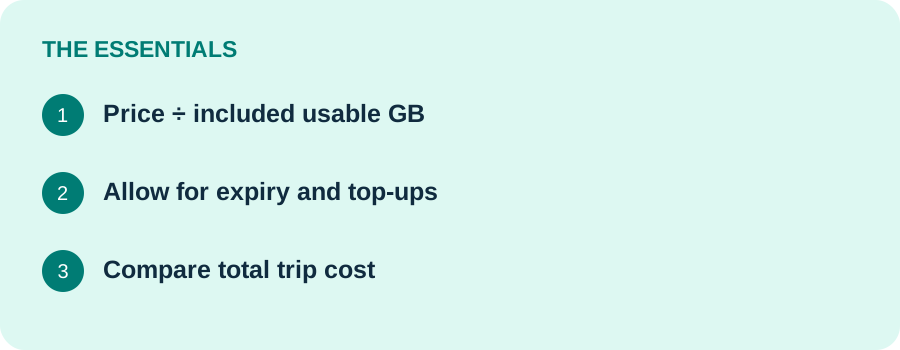
- Price ÷ included usable GB
- Allow for expiry and top-ups
- Compare total trip cost
An eSIM comparison should start with your required destinations, travel days and likely gigabytes, then find the lowest total cost among plans that satisfy them. Dividing price by included data helps, but it does not account for unused allowance, top-ups, expiration or network gaps. A low advertised cost per GB is not proof of the cheapest trip.
The best eSIM comparison combines an eligibility check with transparent calculations. First remove packages that do not cover the itinerary or required functions. Then estimate realistic usage, calculate any extra purchases and examine high-speed restrictions before ranking prices.
What Is the Basic eSIM Comparison Cost-per-GB Formula?
The standard eSIM comparison formula is the total plan price divided by the stated fixed-data allowance. It provides a nominal price per advertised gigabyte. It is useful only when the packages are otherwise comparable in coverage, duration and service features.
Nominal cost per GB = total price ÷ included GB
For hypothetical Plan A at $12 for 5 GB, the result is $2.40 per GB. For hypothetical Plan B at $18 for 10 GB, the result is $1.80 per GB.
| Hypothetical option | Price | Data | Nominal $/GB |
|---|---|---|---|
| Plan A | $12 | 5 GB | $2.40 |
| Plan B | $18 | 10 GB | $1.80 |
| Plan C | $24 | 20 GB | $1.20 |
These are mathematical examples, not current tariffs. Plan C is cheapest by nominal unit price but most expensive in total. For someone needing only 3 GB, that distinction matters immediately.
A fair eSIM comparison should never compare two plans with different territorial eligibility as if they were identical products. Before calculating any unit price, remove options that omit required countries or use unsuitable local networks. An eSIM comparison based only on gigabytes and dollars can recommend a plan that cannot connect on part of the journey. Coverage and validity are pass-or-fail requirements before arithmetic becomes useful. This makes the final comparison meaningful rather than merely precise-looking.
Why Does Actual Data Consumption Matter?
An eSIM comparison based on actual usage reveals the financial effect of buying excessive capacity. If a traveler purchases 10 GB but uses only 3 GB, the effective cost per used gigabyte is the total payment divided by 3. Unused data may expire without providing additional value.
Effective cost per used GB = price paid ÷ data actually consumed
In the previous example, using 3 GB makes Plan A effectively $4 per used GB and Plan B $6 per used GB. Plan A therefore has a lower trip cost even though its nominal unit price is higher.
The traveler should still keep a buffer for unexpected navigation or work. Buying the smallest possible number without considering the risk of running out can also be a false economy.
The effective-cost method is especially revealing for light users. In an eSIM comparison, a 20 GB bundle can appear economical while leaving most of its allowance untouched. A stronger eSIM comparison shows both nominal dollars per gigabyte and the likely total payment for the traveler's own data budget. Estimating that budget requires considering hotel Wi-Fi, offline navigation and streaming. Even a simple usage slider can help users avoid paying for capacity they are unlikely to consume.
How Can a Top-Up Reverse the Cheapest-Plan Ranking?
An eSIM comparison must include required top-ups when a package is too small for expected usage. A $12 product may appear inexpensive until additional data is purchased. A larger package can become the cheaper choice after accounting for extensions.
Suppose expected use is 7 GB. Plan A contains 5 GB and a hypothetical 3 GB top-up costs $9, bringing the total to $21. Plan B contains 10 GB for $18 and therefore needs no top-up in this example.
| Seven-GB requirement | Initial price | Additional spend | Final price |
|---|---|---|---|
| Plan A + top-up | $12 | $9 | $21 |
| Plan B | $18 | $0 | $18 |
Check whether top-ups can actually extend the existing profile and whether the plan remains valid. A quoted add-on that does not extend expiration may not solve the traveler's problem.
Top-up modeling should be explicit. An eSIM comparison might find that a 5 GB package with a 3 GB add-on is cheaper than an 8 GB package, but only if the top-up is available and its validity aligns with the trip. The eSIM comparison should not assume that every service supports recharge or that data and days are extended together. Missing renewal information should be flagged, and users should see the sensitivity of the result to their estimated usage.
Why Is Plan Validity Part of the Real Price?
A correct eSIM comparison filters by the full trip length before ranking prices. A five-day package is not sufficient for a ten-day holiday unless the traveler plans a replacement. Two overlapping purchases may cost more than one suitable longer-validity product.
Validity may begin on installation, purchase or first network connection depending on the product. Some packages count calendar days, others consecutive time periods. A late arrival can influence the usable duration under those rules.
A plan's unused balance is not automatically transferable to another trip. Compare how expiration works, not just the date printed in the product card.
High-speed data is a better basis for some unlimited-plan calculations than a theoretically endless allowance. An eSIM comparison can display a verified daily speed threshold, reset rule and any throttled-speed information. If an eSIM comparison treats the word unlimited as unlimited full-speed access, it can mislead customers who expect remote-work performance. The exact policy must come from the current tariff. A plan may offer continued low-speed connectivity without meeting the demands of video meetings or large uploads.
Find the right eSIM for your trip
Compare prices, coverage, data allowances and validity in one place. Choose a plan that fits your journey, not just the lowest advertised price.
How Can You Compare Unlimited and Fixed Data?
An eSIM comparison should not divide an unlimited plan's price by an imaginary infinite amount of data. Instead, compare the documented full-speed allowance, throttling policy, reset time and practical usage. Unlimited-style products can differ substantially in how quickly reduced speeds begin.
For illustration, a seven-day plan that expressly includes 2 GB of high-speed data per day would offer up to 14 GB at that threshold if each day's allowance is fully available. This does not mean every unlimited plan uses that structure or that all 14 GB are pooled. The actual reset conditions matter.
If the high-speed allocation is not disclosed, show it as unverified. Do not invent a figure to make the rankings appear complete.
A final eSIM comparison result should explain why the recommended package won. Show the expected trip cost, whether a top-up is anticipated, the unused-capacity margin and any material exclusions. An eSIM comparison without visible assumptions can look authoritative while hiding a simple math error. Allow readers to change days, daily data or destination list and see the ranking update. This creates a genuinely useful calculator rather than a decorative price table.
What Must Be Counted for a Multi-Country Itinerary?
A multi-country eSIM comparison should total every required destination package. A regional plan might be cheaper than several national products, or an individual country plan plus a small regional add-on might win. The correct result depends on route and duration.
A regional label should not be accepted as complete coverage without verifying each country and territory. Switzerland, UK and various European microstates are common coverage differences in commercial Europe products. Asian packages can likewise list Hong Kong, Macau and mainland China separately.
Keep offshore maritime internet outside the price of land-based country data unless a product explicitly includes it. A cruise itinerary needs separate planning for ship Wi-Fi and port connections.
How much data should you plan for?
A simple planning estimate, based on your own expected use.
Why Should Network and Hotspot Requirements Be Filters?
Yes. An eSIM comparison should treat mandatory services as eligibility rules. A business traveler needing tethering cannot fairly compare a prohibited-hotspot package with one designed for laptop sharing. A traveler requiring conventional SMS needs verified voice-capable service.
Local network suitability is equally important. A product with a low unit price but no reception at a remote accommodation cannot meet the trip's needs. A reliable LTE option may be more useful than a theoretical 5G maximum on another network.
Only after these constraints are satisfied should price-per-GB become a meaningful ranking signal. This avoids recommending a cheap but unusable plan.
How Should the toptravel esim Cost Calculator Work?
An toptravel esim eSIM comparison calculator should ask for countries, travel dates and an estimated daily data budget. It can multiply expected daily use by trip length and add a configurable buffer. It should then filter products by destination and validity, calculate top-up requirements and rank full-trip costs.
Consider a 12-day trip with an estimated 0.6 GB daily use. Expected data is 7.2 GB, or 8.64 GB after a 20% buffer. A suitable 10 GB package would be worth comparing if it supports all destinations and the full 12 days.
A transparent result can show nominal cost per GB alongside total price, unused-capacity risk and verified restrictions. The recommended plan must satisfy the need first; price decides only among suitable options.
YOUR NUMBERS
What would you pay per usable GB?
Compare the advertised allowance with the data you expect to use before expiry.
Frequently Asked Questions About Comparing Plan Costs
An eSIM comparison FAQ should answer the common mathematical and practical questions directly. The formulas help, but real network and validity conditions still matter. Use them together rather than separately.
How Do You Calculate Cost Per Gigabyte?
Divide the price by the fixed amount of included data. In an eSIM comparison, a hypothetical $15 package with 5 GB is $3 per advertised GB. This does not account for unused data or validity.
Is the Lowest Unit Price Always the Best Deal?
No. An eSIM comparison can show that a larger plan costs more overall even when its nominal rate is lower. Estimate how many gigabytes you will actually use. Include a reasonable buffer.
How Should Unlimited Plans Be Evaluated?
An eSIM comparison should display price, verified high-speed thresholds and fair-use conditions. Do not treat unlimited as an infinite denominator. State when speed-policy details are unknown.
Should You Add Expected Recharge Costs?
Yes. An eSIM comparison can add the cost of additional data required to complete the trip. Verify that the top-up extends a usable profile and does not expire too early. Otherwise, a replacement plan may be needed.
Does Coverage Matter More Than a Low Price?
Absolutely. An eSIM comparison should exclude packages without suitable geographic coverage before calculating the winner. No price advantage compensates for a non-working network at the destination. Compare networks and territory lists.
My quick checklist
Tick off the checks you have completed. Your choices stay in this browser.
0 of 3 checked
Official device support
Menu names and availability can vary by device, software and market. Consult current manufacturer instructions for your exact model.