Key takeaways
- List every stop and territory
- Match country lists to your route
- Compare all required packages
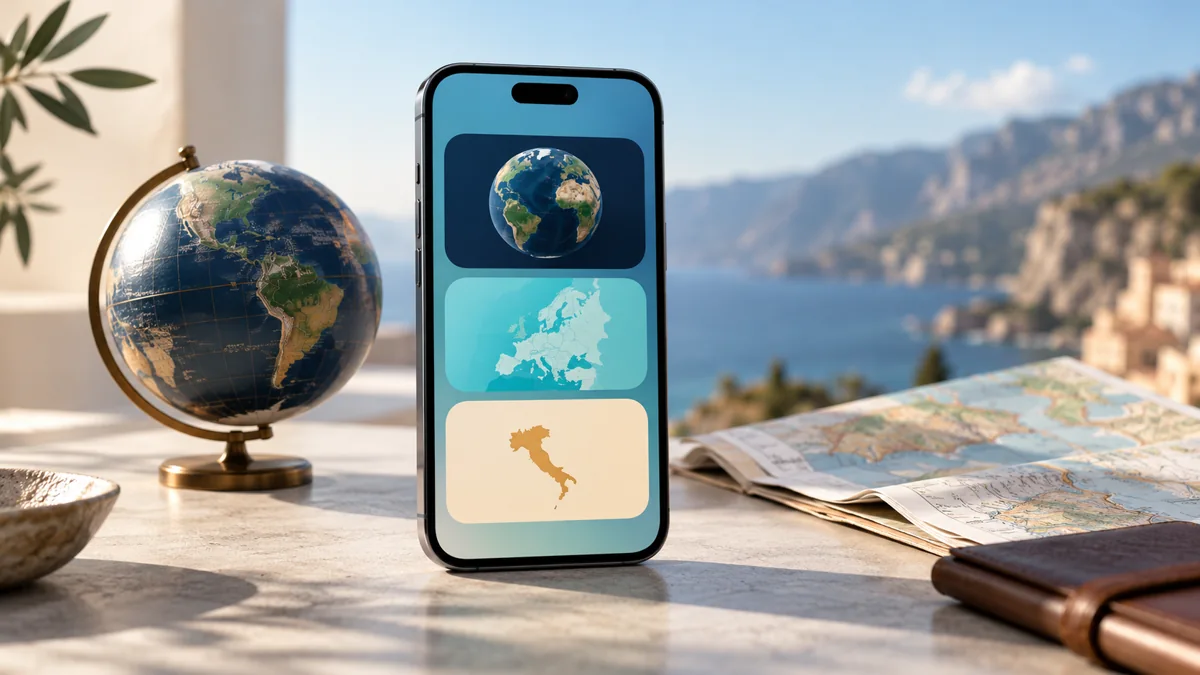
An eSIM global package is designed to cover a broad list of destinations, while a regional package covers a defined area and a country plan focuses on one place. The widest option is not automatically best. Choose the smallest coverage set that includes every stop and provides enough usable data for the full itinerary.
An eSIM global label never means every country on Earth. Small territories, offshore islands, restricted markets and different network partners can create exclusions. Check destination lists before comparing price or assuming that a single digital SIM will work everywhere.
What Does eSIM Global Coverage Actually Include?
An eSIM global product includes an explicitly published group of countries and territories across several regions. Its coverage varies by provider and package, so one global offer can differ substantially from another. A marketing map is not a substitute for a complete destination list.
Some territories are listed separately from neighboring countries. Hong Kong, Macau and mainland China are common examples. The Channel Islands, U.S. territories or remote Pacific islands may also have distinct arrangements depending on the seller.
A global plan should be checked for network access in each important destination. Even valid geographic coverage does not guarantee reception at isolated beaches or mountain trails.
The usefulness of eSIM global coverage also depends on how often the traveler revisits the same destinations. A reusable profile may reduce setup steps but does not guarantee that every new destination package is already included. An eSIM global purchase should clearly distinguish stored profile validity from the paid data allowance. If the traveler changes devices, transfer rules can also matter. Keep the original service terms and check whether the profile can be reinstalled or topped up for another trip.
Find the right eSIM for your trip
Compare prices, coverage, data allowances and validity in one place. Choose a plan that fits your journey, not just the lowest advertised price.
How Do Worldwide, Regional and National Plans Differ?
An eSIM global comparison should distinguish convenience from price and performance. Wider coverage can eliminate extra purchases on an intercontinental itinerary but may add little value to somebody staying in one country. National or regional products may offer different networks and data conditions.
| Attribute | Country | Regional | Global |
|---|---|---|---|
| Intended area | One destination | Defined country group | Broad cross-region list |
| Single-country vacation | Often efficient | Sometimes unnecessary | Often broader than needed |
| Neighboring country stops | Separate plans may be needed | Convenient if all included | Also possible |
| Several continents | Multiple purchases | Several regional products | May simplify |
| Network selection | Product-dependent | Varies by country | Varies by country |
| Voice and SMS | Tariff-specific | Tariff-specific | Tariff-specific |
| Cost advantage | Never guaranteed | Never guaranteed | Never guaranteed |
The SIM format is digital in all three cases. The underlying service agreements, data allowance and network access determine quality.
A regional option can be a better fit for a traveler who wants dense coverage in one geographic area. An eSIM global plan may list many countries while providing no additional benefit to someone who remains in Southeast Asia. Another eSIM global product might offer longer validity that a frequent traveler values more than a lower unit price. These are different priorities, and a comparison should let the reader select them. Country count alone should never determine the ranking.
Country-specific plans
For a trip focused on one named destination. Check validity and local networks.
Explore countries →
Regional plans
For several explicitly included countries. Check borders and special territories.
Check Europe coverage →
Global plans
For broader itineraries. A worldwide label still has a defined country list.
Understand global plans →When Does Worldwide Coverage Make Sense?
An eSIM global plan is worth comparing for frequent international business travel, trips spanning several continents or a long itinerary with many short stops. A reusable profile and longer validity may reduce administration. The convenience has value only if all required destinations and dates are supported.
Suppose a traveler visits Japan, France and Brazil within the same month. A suitable global package might replace three separate purchases. Compare its total usable data and coverage against a combination of national plans.
Another traveler spending two weeks only in Italy is unlikely to benefit from dozens of extra destinations. In that case, local and regional offers can be compared first.
A frequent traveler should compare the eSIM global product's expiration with their actual schedule. One long-validity allowance may be convenient when several journeys occur close together. However, an eSIM global service could have rules restricting unused data or require a top-up after expiration. Those conditions matter more than how many countries appear on the marketing page. A reliable comparison clearly separates the lifetime of the installed profile from the lifetime of the data purchase.
Can a Broad Package Cost Less Than Several National Plans?
Yes, an eSIM global plan can cost less in total when many separate national purchases would be required. However, the reverse can also happen. The correct calculation uses the actual days, data use and top-ups for every destination.
In a hypothetical trip with four countries, four suitable national products at $8 each would cost $32. A suitable regional option at $24 would be cheaper, while a hypothetical global plan at $36 would cost more. These illustrative figures are not current offers.
Different data allowances can invalidate a direct comparison. A cheap product that does not cover all countries is not a complete substitute. Filter by eligibility first, then compare price.
An eSIM global cost calculation should compare the full amount payable, not simply nominal unit prices. Several small national plans can be economical when most days are spent in one location. In other cases, an eSIM global package can reduce repeated purchasing and activation work. Add the cost of any separate destination that the global package excludes. This prevents a seemingly convenient broad product from becoming unexpectedly expensive after another purchase is required.
Which Local Networks Are Available Under a Global Plan?
An eSIM global plan connects through the local operators included in the issuer's roaming arrangements. Those partners can differ by country and can have uneven rural coverage. One global profile therefore does not imply one consistent speed, technology or coverage footprint worldwide.
Check local network partners when available. A package may support LTE or 5G in some locations but not others. Throttling, routing and congestion can also affect performance independent of the destination list.
If a trip includes islands, remote driving or national parks, verify those areas separately. A large number of listed countries does not compensate for the wrong local partner network.
The phrase eSIM global can create expectations of universal network availability. In reality, a phone may move between very different local operators and roaming agreements. An eSIM global profile cannot guarantee 5G, uniform latency or uninterrupted connectivity on ferries and remote roads. The comparison should identify supported networks where documented and mark the rest as unknown. Even frequent travelers benefit from saving essential travel documents offline for locations where terrestrial signal disappears.
What Happens When You Cross a Border?
An eSIM global service may re-register with a supported operator after crossing into another covered country. A temporary data interruption can occur while switching networks. Border roads, tunnels and ferry routes may also have signal gaps.
The package must include the destination on both sides of the border. A global name does not remove territorial exclusions. The phone's own roaming and data-line configuration must match the issuer's instructions.
Download critical tickets, maps and accommodation details for offline access. Continuous connectivity is not guaranteed during flights or at sea, regardless of the geographic package category.

Are Calls and Laptop Hotspot Included?
An eSIM global package can be data-only, just like a national travel package. Conventional voice, a telephone number and SMS must be explicitly included. Geographic reach does not determine those functions.
Hotspot support is also product-specific. A frequent traveler using a laptop should check whether tethering is allowed and whether unlimited-style service has a high-speed threshold. A broad geographic package with restricted hotspot may not meet remote-work requirements.
Keep your home number active on a supported dual-SIM device if needed, but review the home carrier's roaming charges. A separate global prepaid profile does not control the home line's bill.
How Should You Choose Between the Coverage Types?
To decide whether an eSIM global product is worthwhile, list the actual countries first. Compare a country-only combination, relevant regional packages and eligible global products on equivalent validity and data requirements. Include extra purchases that would otherwise be necessary.
- Identify every country and special territory.
- Determine total travel days and estimated gigabytes.
- Filter out incomplete destination lists.
- Check local operators and necessary hotspot or voice functions.
- Calculate the full-trip cost including top-ups.
- Choose the cheapest suitable arrangement with acceptable conditions.
A traveler can also combine products, such as a regional plan for most destinations and a national profile for a country omitted from the region. It is not always necessary to use one category exclusively.
Frequently Asked Questions About Global Coverage
An eSIM global FAQ must explain why the broad label can still contain exclusions. Price, local coverage and telephone features are separate questions. The answers below apply to selecting the right class of package.
Does Worldwide Coverage Mean Every Country?
No. An eSIM global package works only in its published list of countries and territories. Small islands and certain destinations can be excluded. Check the actual product list.
Is a Broad Plan Cheaper for a World Trip?
Sometimes. An eSIM global product may simplify and reduce the cost of multiple purchases, but separate regional offers may be cheaper. Compare the full route and required data.
Is 5G Guaranteed Everywhere?
No. An eSIM global service depends on local networks, compatible devices and plan restrictions. 5G availability varies by country and location. Full-speed limits may also apply.
Can You Share a Worldwide Package With a Laptop?
Only when permitted. An eSIM global package may restrict tethering or impose separate high-speed limits. Check the exact product before relying on remote work.
Is Global Coverage Useful for One Country?
Usually it is worth comparing national plans first. An eSIM global package can still be suitable if the total cost and terms are competitive, but unused worldwide coverage adds no direct benefit to a single-country trip.
My quick checklist
Tick off the checks you have completed. Your choices stay in this browser.
0 of 3 checked
Official device support
Menu names and availability can vary by device, software and market. Consult current manufacturer instructions for your exact model.